
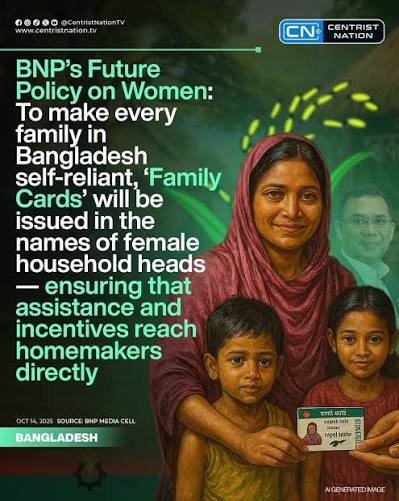
A government benefit arrives because a woman’s name is on the card.
But whose phone receives the money?
Who knows the PIN?
Who decides whether it will pay for food, medicine, school fees or something else?
And if the mobile wallet belongs to her husband or another family member, is the benefit really under her control?
These questions are becoming increasingly important as Bangladesh expands its Family Card Programme, a new social-protection system designed to provide regular financial support to vulnerable households while placing women at the centre of delivery.
A new policy note published on August 26 by the government-backed Social Security Policy Support Programme, an initiative of the Cabinet Division and General Economics Division of the Planning Commission, argues that the Family Card could become a foundation for a more integrated national social-protection system.
It also identifies significant challenges involving targeting, digital exclusion, payment problems, data security and women's actual control over benefits.
The central question for SheFront is therefore not simply whether Bangladesh is giving cards to women.
It is whether those cards can translate into real financial agency.
How does the Family Card work?
The Family Card was launched in March 2026.
Under the model, one card is issued per household in the name of the female head of the family, and financial assistance is delivered digitally through a mobile financial service account or bank account.
Government programme documents describe the card as more than a cash-transfer mechanism. The long-term aim is to create a digital social-protection identity through which households can receive multiple forms of government assistance.
At the programme's launch, the government transferred benefits to 37,567 women across selected areas, according to Bangladesh Sangbad Sangstha.
Beneficiary families have been receiving Tk 2,500 per month during the current phase.
In July, the government also announced plans to bring 41 lakh families under the programme within a year as part of a wider national expansion.
That makes the programme potentially significant not only for poverty reduction, but also for women’s economic position inside millions of households.
Why put the card in a woman’s name?
The policy has an intentional gender dimension.
Government officials have repeatedly presented issuing the card to female household heads as a way of recognising women’s status within the family and strengthening women’s empowerment.
There is logic behind that approach.
Women frequently manage everyday household spending — food, children's needs, medicines and other essentials — while having less access than men to formal income and financial services.
Giving social-protection money directly to a woman can potentially increase her ability to make decisions about those necessities.
It can also provide something more basic:
money connected to her own identity.
For a woman with little or no independent income, even a modest predictable transfer can create a degree of financial security.
But only if she can actually access and control it.
The government’s own field research shows the difference
A July 2026 focus-group study by the Social Security Policy Support Programme examined the first three months of Family Card use among 14 beneficiaries living in Korail, one of Dhaka’s largest informal settlements.
Women said the money helped cover expenses such as:
food;
healthcare;
children's education;
and other daily household costs.
That is encouraging.
But researchers also identified digital financial exclusion and reduced financial autonomy when mobile financial service accounts were not registered in the women’s own names.
That finding goes directly to the heart of the programme.
A card can have a woman's photograph or name on it.
But if payment goes to someone else's account, she may still have to ask another person for access to the money.
She may not know the account PIN.
She may not be able to check whether the full payment arrived.
And she may have less say in how the transfer is used.
In that situation, the programme formally recognises her as the beneficiary while financially leaving another person in control.
Bangladesh still has a large financial gender gap
This risk matters because women in Bangladesh remain less connected to formal financial systems than men.
World Bank financial-inclusion data for 2024 show that around 33% of Bangladeshi women had an account with a financial institution or mobile-money provider, compared with 54% of men.
The gender gap has widened compared with earlier periods.
That means making government benefits digital can produce two very different outcomes.
For a woman with her own account, phone and financial literacy, digital transfer can increase independence.
For a woman without them, digitisation can create another intermediary between her and her money.
The technology is therefore not automatically empowering.
Who controls the technology matters.
Financial empowerment is more than receiving cash
If Bangladesh wants to evaluate whether the Family Card empowers women, the government will need to measure more than the number of cards issued in female names.
It should also ask:
Can the woman withdraw the money herself?
Is the mobile wallet registered in her own name?
Does she control the PIN?
Can she independently check the balance and transaction history?
Does she decide how at least part of the money is spent?
Can she save any portion of it?
Does receiving the transfer increase her influence over household decisions?
And does anyone pressure her to hand over the benefit?
These questions distinguish financial inclusion from financial control.
A woman can technically be included in a programme without becoming more powerful within her household.
The early evidence is promising — but limited
The new August 26 policy note says early implementation and beneficiary consultations have generally produced positive responses.
Recipients value the assistance, particularly at a time of high living costs.
But the government paper also identifies weaknesses involving:
unclear eligibility information, payment errors, digital exclusion, targeting problems, urban poverty coverage and data protection.
These findings should also be interpreted carefully.
The early field studies are qualitative and involve relatively small groups of beneficiaries. They cannot yet tell us whether Family Cards are increasing women's financial decision-making across Bangladesh.
That will require much larger and more systematic evaluation as the programme expands.
Who gets a card is another major question
Any social-protection programme faces a difficult problem:
How do you identify the people who genuinely need assistance?
The Family Card uses household data and a Proxy Means Test, combined with door-to-door information collection, to identify eligible families.
The new policy note says Bangladesh needs stronger beneficiary identification systems, including:
an integrated national beneficiary database;
real-time verification;
regular updating when household circumstances change;
better coordination between government programmes;
and greater inclusion of people in informal work and underserved urban areas.
This is particularly important for women.
A divorced woman may suddenly become financially vulnerable.
A widow's circumstances can change overnight.
A woman may leave an abusive household.
A family may lose its main income.
A static database can fail women whose lives change after the original registration.
Social protection therefore needs to be able to update with people's lives.
Privacy cannot become the hidden cost
Building one integrated digital welfare system also creates another challenge: data protection.
To determine eligibility, governments may collect substantial information about household income, family structure, disability, employment and other personal circumstances.
The August policy note specifically identifies data security as an issue requiring stronger protection.
For women, some information can be particularly sensitive.
Social-protection systems should therefore clearly define who can access beneficiary information, why it is being collected, how long it is retained and how errors can be corrected.
Financial assistance should not require vulnerable women to sacrifice unnecessary privacy.
Could the Family Card become more than an allowance?
This may ultimately be the programme’s biggest opportunity.
The government does not envision the Family Card solely as a monthly cash payment.
Official programme documents describe it as a future platform capable of connecting households with multiple social-protection services.
If designed carefully, a woman receiving a Family Card could potentially be connected with:
financial accounts,
skills programmes,
health benefits,
food assistance,
disability support,
employment services,
or other government programmes.
That could make the card a doorway into a broader economic-support system.
But the August policy note also warns against Bangladesh's existing problem of fragmented social programmes operating through separate databases and administrative systems.
Its recommendation is essentially to make these systems communicate with each other.
For beneficiaries, that could mean fewer forms, fewer repeated registrations and fewer opportunities to fall through administrative gaps.
Putting a woman’s name on the card is a beginning
There is something symbolically powerful about a government identifying the woman of the household as the person through whom support is delivered.
For some women, that recognition may also carry practical power.
The early beneficiary research suggests direct financial support is already helping families pay for food, medicine and education.
But symbolism should not be confused with empowerment.
A card in her name matters.
An account in her name matters more.
Knowing how to use it matters.
Being able to keep control of the payment matters.
And having a genuine say in what happens to the money matters most.
As Bangladesh considers turning the Family Card into one of the country's largest social-protection platforms, it has an opportunity to build women's financial autonomy into the system rather than treating it as an automatic side effect.
The government should therefore measure success not only by asking:
How many women received a Family Card?
It should also ask:
How many women gained greater control over their financial lives because of it?
That is the difference between putting money in a woman's name —
and putting economic power in her hands.
SheFront Source Note
This explainer was independently developed by SheFront News Desk following publication of the August 26, 2026 policy note Family Card and the Next Phase of the NSSS by Bangladesh's Social Security Policy Support Programme.
SheFront cross-checked the policy note against the programme's official Family Card knowledge brief, July 2026 beneficiary focus-group findings, government launch information reported by BSS, and World Bank financial-inclusion data.
Important context: Early Family Card beneficiary studies are qualitative and should not be interpreted as nationally representative evidence that the programme has already increased women's financial autonomy.
Join the discussion