
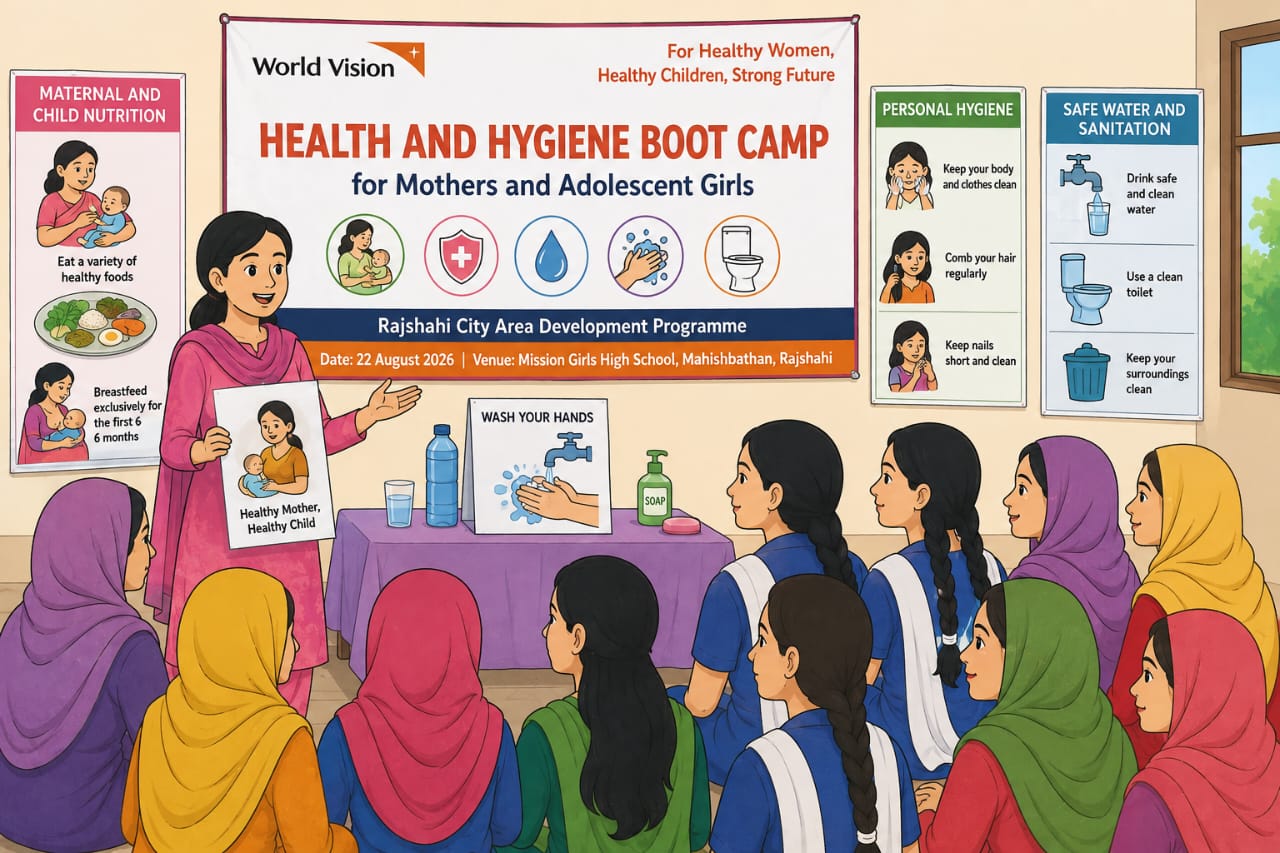
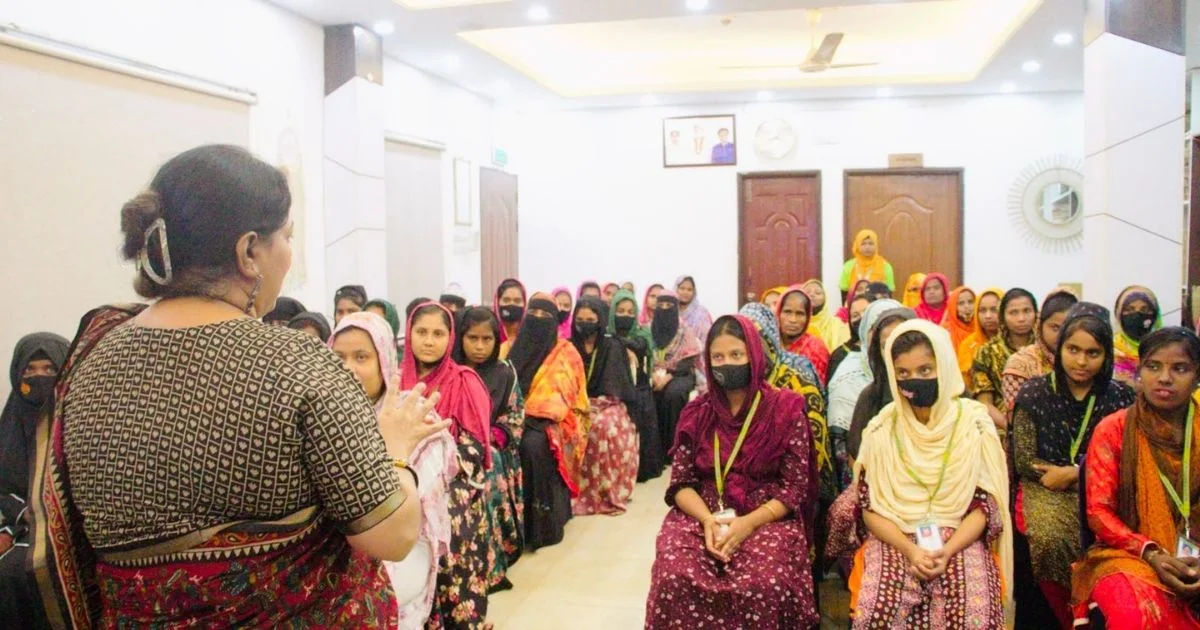
Two hundred and fifty mothers and adolescent girls in Rajshahi have taken part in a practical health and hygiene programme aimed at helping women and girls make healthier decisions for themselves and their families.
The programme was organised by World Vision Bangladesh's Rajshahi City Area Development Programme at Mission Girls High School in the Mahishbathan area of Rajshahi city on August 22.
Rather than relying only on speeches, organisers arranged 10 health and hygiene boot-camp booths, where participants could learn through practical activities.
A total of 100 mothers of children aged 0–59 months and 150 adolescent girls participated, with 25 participants attending each booth.
What did women and girls learn?
The sessions covered several everyday health issues that can have long-term effects on women, children and families.
Topics included:
maternal and child nutrition;
safe motherhood;
childhood immunisation;
childcare;
personal hygiene;
adolescent girls' hygiene;
safe drinking water;
sanitation;
and everyday practices for healthier living.
Participants were also encouraged to practise some of the behaviours being discussed rather than simply listening to instructions.
Rajshahi Deputy Commissioner Kazi Shahidul Islam, who inaugurated the programme, said healthy child development depends on more than medical treatment.
Maternal nutrition, appropriate childcare, vaccination, hygiene, safe water and sanitation all contribute to a child's health, he said.
Why focus on adolescent girls too?
One particularly important feature of the programme was that it did not focus only on mothers.
Adolescent girls were included as a separate and significant group.
Adolescence — generally defined by the World Health Organization as ages 10 to 19 — is a critical period of physical, emotional and social development.
Bangladesh's National Adolescent Health Strategy 2017–2030 identifies adolescent sexual and reproductive health, nutrition, mental health and protection from violence as major areas requiring action.
Knowledge learned during these years can influence not only a girl's health today but also her health in adulthood.
Nutrition is one example.
WHO notes that nutritional deficiencies during adolescence can have lasting effects and that anaemia among adolescent girls is an important health concern, particularly because poor nutrition can later affect pregnancy and maternal health.
Menstrual hygiene is another area where information matters.
UNICEF has previously reported that many Bangladeshi girls enter menstruation without adequate prior knowledge, while inadequate menstrual facilities and stigma can interfere with school attendance.
Teaching girls about their bodies before a problem occurs is therefore not simply health education.
It can be a form of prevention.
Mothers also continue to face major health challenges
Health education remains equally important after a woman becomes a mother.
Bangladesh has made significant progress in maternal and child health, but preventable nutritional and health problems remain common.
The Bangladesh Multiple Indicator Cluster Survey 2025, conducted by the Bangladesh Bureau of Statistics with UNICEF, found that 53.1% of pregnant women surveyed had anaemia.
That figure illustrates why conversations around nutrition cannot begin only after a woman develops complications.
Women need understandable health information before pregnancy, throughout pregnancy and after childbirth.
The same applies to child nutrition, vaccination, hygiene and recognising when a child needs medical attention.
Why practical learning can matter
Health information is available from many sources today.
But receiving information does not automatically mean someone knows how to apply it.
That is one reason the Rajshahi programme's hands-on approach is noteworthy.
Participants could engage directly with activities covering nutrition, hygiene, safe water and healthy living, while also discussing their experiences and asking questions.
Organisers said this approach was intended to help women and girls take what they learned back into everyday family life.
For a mother, that could mean understanding why vaccination schedules matter or how hygiene can reduce illness in young children.
For an adolescent girl, it may mean having better information about nutrition, menstrual hygiene and caring for her own body.
Small programmes, larger potential
A programme involving 250 people in one city will not by itself transform Bangladesh's maternal or adolescent health indicators.
Its significance lies in the model.
Health systems are essential when someone becomes sick.
But many health problems can also be reduced through earlier knowledge, healthier environments and timely preventive care.
That means useful health information needs to reach girls before adulthood, women before pregnancy, and mothers before a health problem becomes an emergency.
Rajshahi's programme brought those stages of a woman's life into the same conversation.
That is an approach worth expanding.
Because healthier families do not begin only inside hospitals.
They often begin when a woman or girl has the knowledge and confidence to make an informed decision about her health.
SheFront Source Note
This story was independently developed by SheFront News Desk following a health and hygiene programme organised by World Vision Bangladesh's Rajshahi City Area Development Programme on August 22, 2026.
SheFront used event information reported by Bangladesh Sangbad Sangstha (BSS) and added independently sourced public-health context from the World Health Organization and UNICEF/Bangladesh Bureau of Statistics.
Join the discussion