
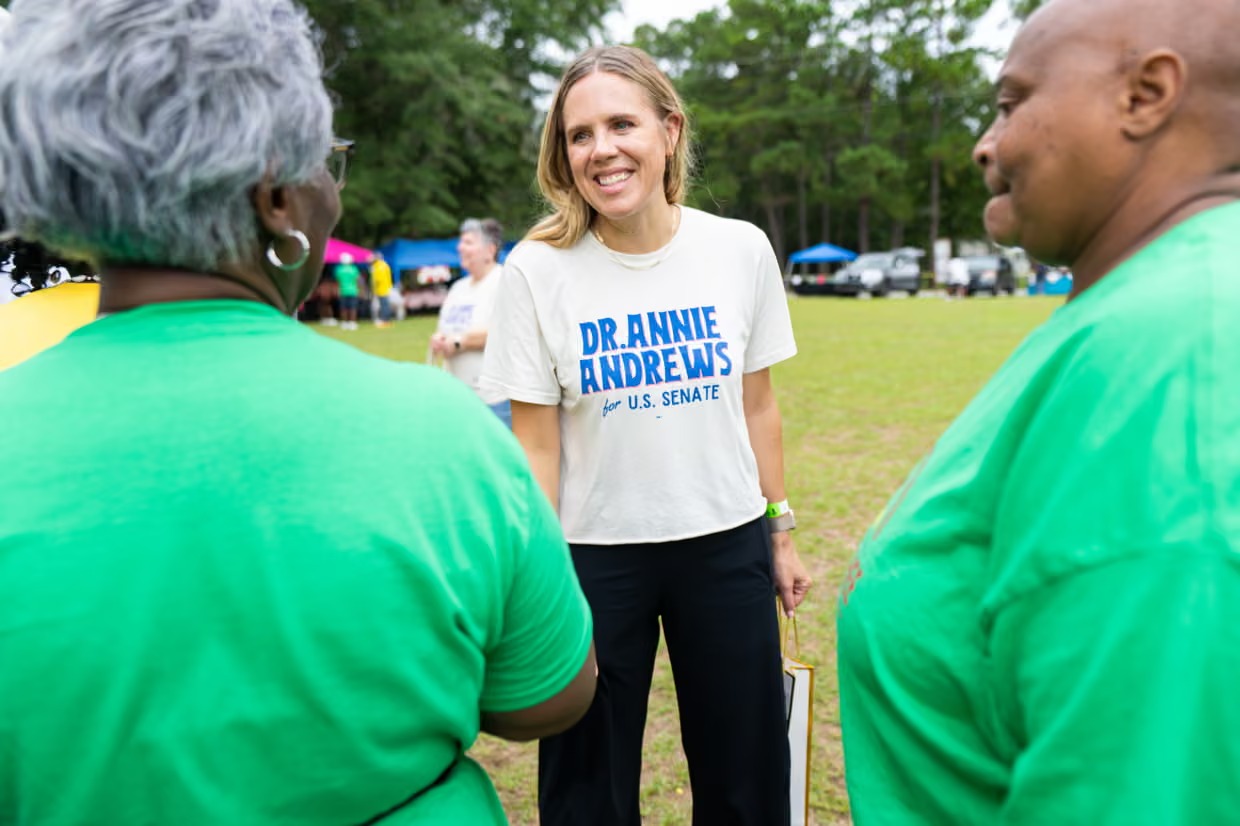
CHARLESTON, South Carolina — Paediatrician Annie Andrews is asking South Carolina voters to treat experience from children’s hospital rooms as preparation for national political office.
Andrews, who has practised medicine for nearly two decades, is the Democratic nominee in a US Senate contest against Republican Darline Graham.
Graham was appointed to complete the term of her late brother, Senator Lindsey Graham, before winning the Republican runoff. South Carolina remains strongly conservative, making Andrews’ campaign an electoral challenge as well as a test of professional credibility.
A profile published by The Guardian on 31 August places her within a broader movement encouraging doctors and scientists to seek office.
The political organisation 314 Action says it wants to elect 100 physicians to Congress by 2030. According to figures cited by The Guardian, only about 20 current members are doctors.
Medical work can provide legislators with practical knowledge of vaccination, insurance, mental health, injury, reproductive care and how poverty appears inside a clinical encounter.
Andrews has made firearm injury, children’s health and access to care central to her public profile. As a paediatrician, she has treated consequences that political debates often reduce to statistics.
Professional expertise is valuable, but it should not become immunity from political scrutiny. A doctor running for office must still explain budgets, constitutional reasoning, foreign policy and the trade-offs within healthcare proposals.
Clinical authority also operates differently in democracy. A physician can recommend treatment based on evidence and individual circumstances. A senator must negotiate legislation affecting millions of people who may hold conflicting values and needs.
Women physicians face another layer of expectation. They may be asked to demonstrate empathy while also proving toughness, or be judged more closely for translating professional achievement into ambition.
Andrews’ campaign should therefore be assessed through the quality of her policies and coalition-building rather than celebrated simply because a woman doctor entered the race.
Her candidacy does offer a meaningful leadership model. Medicine teaches that policy decisions arrive in people’s bodies: an uninsured child, a parent delaying treatment or a family living with preventable injury.
That experience can improve government only if it is connected to legislative skill, accountability and respect for evidence outside one’s own speciality.
South Carolina voters will decide whether Andrews makes that transition convincingly. The wider experiment concerns whether expertise can enter highly partisan politics without being simplified into a campaign credential.
A white coat establishes what she has done. Leadership will depend on what she can persuade a divided public to do together.



Join the discussion