
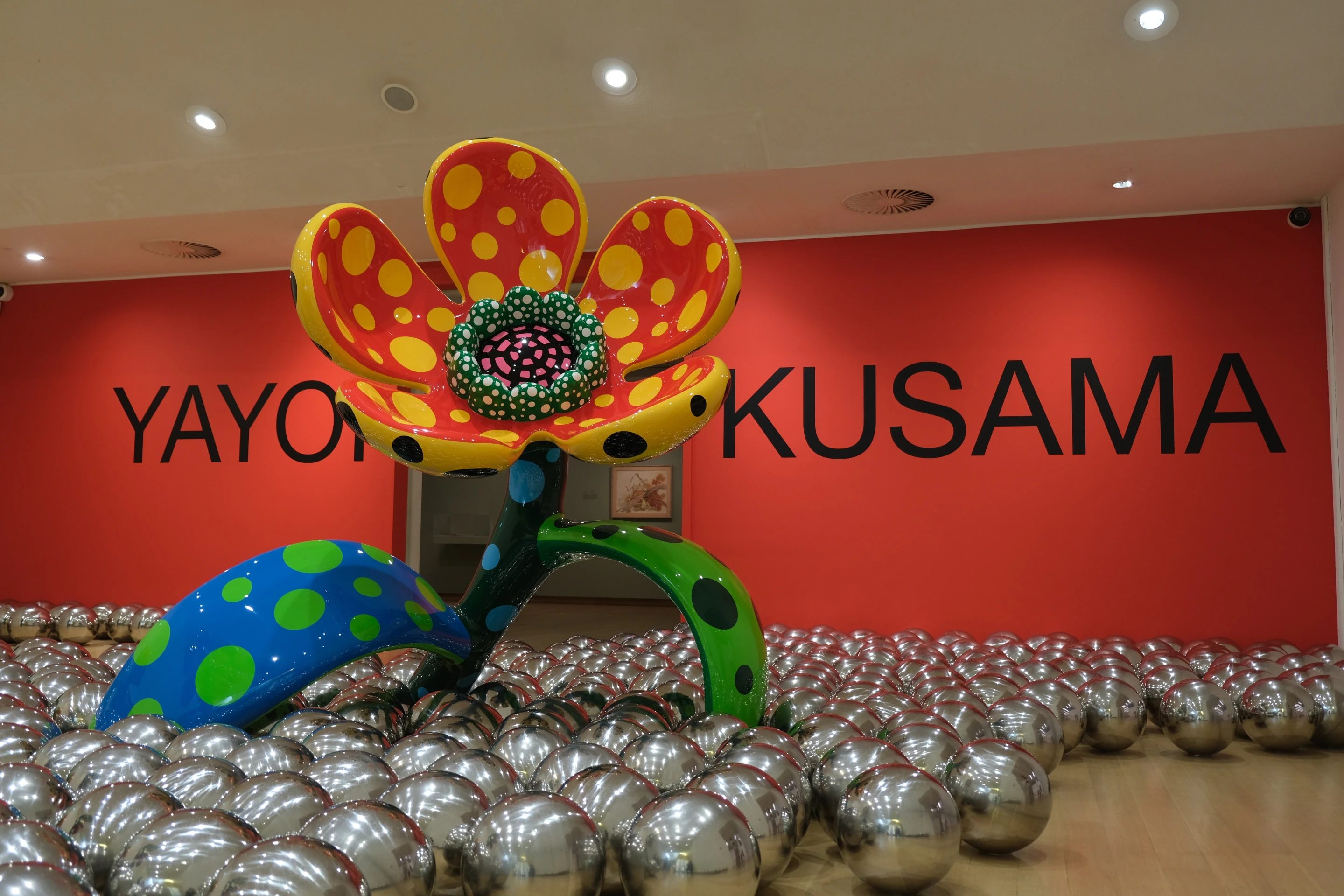
AMSTERDAM — A major Yayoi Kusama retrospective opening at Amsterdam’s Stedelijk Museum on 11 September has become a posthumous assessment of the Japanese artist’s seven-decade career following her death on 14 August at age 97.
The exhibition, planned before her death, occupies two floors and runs until 17 January 2027. It includes paintings, sculpture, installation, archival material and one of the immersive mirrored environments that helped make Kusama one of the world’s most recognisable artists.
Visitors will also encounter her visual language outside the galleries. The museum has covered parts of its façade and nearby trees with dots, turning Amsterdam’s Museumplein into an extension of the show. That public spectacle will draw crowds, but it risks narrowing a complex practice to a photogenic pattern.
Kusama’s repeated dots and nets emerged long before social media made immersive art a cultural product. She described hallucinations beginning in childhood and used repetition to dissolve the border between body and environment. In New York during the 1960s, she staged happenings, made soft sculptures and competed for attention in an art world that often rewarded male peers for related experiments.
Amsterdam is a meaningful place for the survey. Kusama developed ties with the Netherlands during the 1960s, participating in exhibitions and performance networks that linked European and American avant-garde circles. The Stedelijk can therefore present her as an active participant in postwar art history, not an isolated eccentric imported from Japan.
Her biography also demands care. Kusama lived voluntarily at a psychiatric hospital in Tokyo from the late 1970s while working daily in a nearby studio. Accounts that turn that arrangement into a romantic story of madness producing genius can obscure her discipline, business decisions and command of a large studio practice.
The institution should also address how gender, race and nationality shaped her reception. Kusama’s work was visible in New York, yet histories of Pop, Minimalism and performance often centred white men. Her later global popularity corrected some exclusion while creating a new problem: the artist as brand, endlessly reproduced across merchandise and queues.
A posthumous exhibition can freeze an artist into a final narrative. This one has a better opportunity—to show contradictions, failed experiments, political performances and changing markets alongside the famous rooms.
Kusama’s mirrored spaces ask viewers to see themselves multiplied and made small. The Stedelijk’s task is similar: place a monumental public image back inside the networks, vulnerabilities and relentless work that produced it.


Join the discussion